Plutus
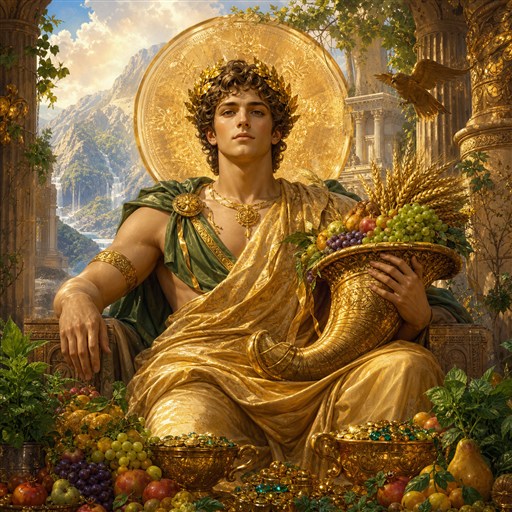
The wealth of Plutus has the weight of ripened fruit and the promise of a full granary. This Greek personification of wealth, also called Ploutos, belongs to the abundance of the earth. His name means wealth; his stories give that wealth a face, a family, and a place among the gods.
For modern devotion, he offers a rich presence at a harvest altar or a household blessing: plenty welcomed with gratitude, cared for while it lasts, and shared beyond the self.
Born in Demeter's field
One Greek account places his beginnings in a thrice-ploughed field on Crete, where Demeter and Iasion come together. Their son, Plutus, brings wealth to those he encounters. His birth links the goddess of the harvest with cultivated earth, placing abundance among the furrows.
That is a powerful image to carry into ritual. A field holds possibility long before the harvest appears. In a contemporary working for abundance, grain and fruit can give that possibility a visible place on the altar.
The blind god of wealth
The ancient comedy Plutus imagines Wealth as a blind figure. Zeus has taken his sight after he intended to favour good people, and a man named Chremylus hopes to restore it so that riches can reach the deserving. The story makes the uneven distribution of fortune a subject of satire.
This is part of what makes Plutus more interesting than a simple promise of riches. Wealth wanders; it does not reliably measure virtue. In devotion, requests for prosperity can sit beside compassion for those who struggle. Hardship is no mark of spiritual failure.
The horn of plenty and the arms of Peace
The cornucopia, or horn of plenty, gathers the harvest into one overflowing image. Fruit spilling from its mouth makes abundance tangible: something grown, gathered, and offered.
Plutus also appears as an infant carried by Eirene, the personification of Peace. The image gives wealth a tender aspect. Held in the arms of Peace, it becomes something that needs protection and conditions in which to flourish.
For a modern altar, choose a cornucopia image, a small bowl of grain, or a piece of seasonal fruit. Let the harvest shape the space. These are contemporary devotional choices inspired by his imagery, rather than a prescribed ancient altar arrangement.
A harvest blessing for Plutus
Set a clean bowl on a cloth and place a little grain or a piece of fruit inside. Add an image of a cornucopia or a card bearing the name Ploutos. This original rite can be offered when you bring food into the home or celebrate the completion of work.
Hold your hands open beside the bowl and speak this invocation, written for the practice:
“Ploutos, child of the furrow,
Wealth held in the arms of Peace,
May this home be nourished,
May honest work bear fruit,
And may the plenty gathered here
Find open hands beyond this door.”
Rest the bowl before his name for the duration of the rite. Name the blessing you seek plainly—a well-provisioned home, fruitful work, or the means to be generous—and close with thanks. Remove the food before it spoils; if it remains safe to eat, it can become part of a meal.
Complete the offering with an act of sharing when you are able. A meal, a useful skill, or time given freely can carry the blessing outward. This devotional practice honours prosperity without promising a particular financial result.
Plutus or Pluto?
The names are closely related, but they are not interchangeable. Plutus personifies wealth; Pluto, or Plouton, is a name associated with Hades, ruler of the underworld. Their ancient associations overlap through the riches of the earth. When preparing this altar, use Ploutos to make the intended dedication clear.